español


 Sistema de montaje en tierra
 sistema de montaje en techo
 Sistema de montaje de cochera
 sistema de montaje de granja
 Easy Solar Kit
 sistema de seguimiento solar
 inversor solar
 Accesorios solares
Delta Electronics' on-site microgrid delivers valuable solar + storage insights
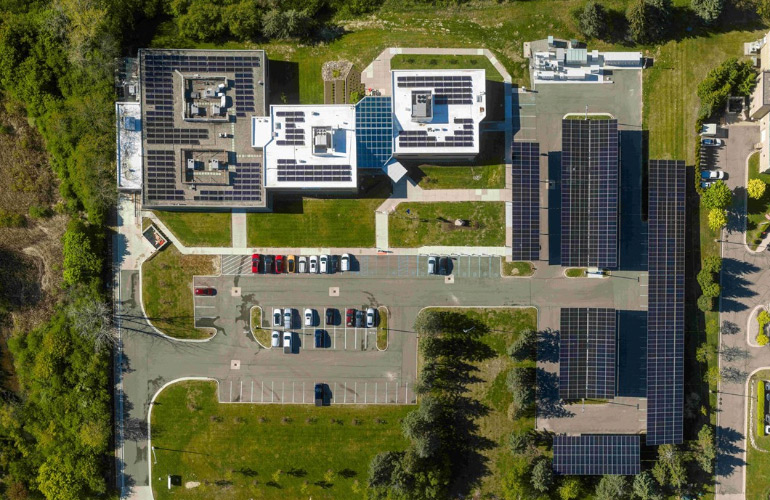
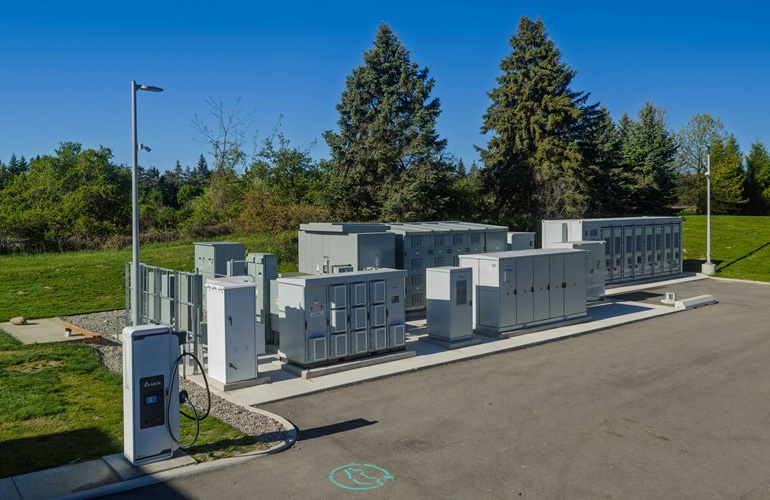
Delta Air Lines' Detroit plant's on-site microgrid integrates 425 kW of solar power generation, eight Level 2 electric vehicle chargers, and a 400 kW DC fast electric vehicle charger developed under a Department of Energy-funded project. The microgrid connects these assets via a 13.2 kV medium-voltage interconnection provided by DTE Energy—a point on the grid typically reserved for utility-scale infrastructure, completed in April. The microgrid is supported by Delta's 3 MW Power Conditioning System (PCS) and a 2.8 MWh fixed BESS. At the software level, the microgrid's operation is controlled by Delta's Energy Management System (EMS) and monitored by the internal VTScada SCADA platform.
The core of this system is the Solid-State Transformer (SST), funded by the U.S. Department of Energy. Unlike traditional passive transformers, the SST employs digitally controlled power conversion to achieve faster grid response, real-time voltage regulation, and more precise coordination across the entire microgrid. This enhances system efficiency and enables more accurate power flow control under dynamic load conditions.
These assets collectively reduce the facility's reliance on the grid by approximately 50% annually. During summer, solar power generation should suffice to supply the entire building, achieving net-zero operation. In the remaining six months of the year, energy storage provides load balancing to lower peak demand costs and reduce the facility's electricity expenses.
Once fully operational, the device will run daily under real-time grid conditions, helping alleviate pressure on public infrastructure during peak demand periods and generating authentic performance data on how to build and expand commercial energy systems. It provides insights that can assist businesses and data center operators in reducing peak demand costs and enhancing power reliability. The site is open for customer participation to evaluate microgrid performance and grid interaction strategies under actual operating conditions.
William Mao, Vice President of Energy Solutions at Delta Electronics Americas, stated, "Laboratory tests demonstrate the independent performance of a technology." "They do not reveal how the system interacts when connected to the real-time grid. The data and experience provided by daily usage directly determine how to design and deploy resilient, grid-interactive energy systems at scale."
The microgrid is expected to establish five energy storage circuits on this basis, including two back-to-back 5 MWh units to be installed by the end of the year, configured to simulate large power loads. This will enable Delta to test black-start scenarios, off-grid switching, and grid loss recovery without requiring on-site megawatt-level physical loads. Additionally, a 300 kW gas turbine is planned to be installed to enhance the ability to study how solar, storage, and natural gas power generation interact under changing grid conditions.
Para consultas sobre nuestros productos o lista de precios, déjenos en nuestras manos y nos pondremos en contacto dentro de las 24 horas.
 RM502, Sihai Smart Zone, No.189, Fanghu West Road, Huli District, Xiamen, Fujian, China.



© Derechos de autor: 2026 Xiamen Wintop New Energy Tech Co., Ltd.. Reservados todos los derechos.

Compatible con red IPv6